Category: Projects

  • Wiring: Plan B

    As is often the case with these things, I hit a snag trying to fish wire from the attic to the basement for my bedroom rewiring project. I encountered some horizontal blocking in the stud cavity which prevented me from running the wire all the way through. That basically left me with three choices:

    1. Press forward and try to run the wire through the cavity as planned, turning most of my hair gray and losing several years from my life expectancy in the process;
    2. Try to find an alternate stud cavity to run my wire; or
    3. Come up with another plan altogether.

    I’ll admit, I briefly considered #1. I’ve fished wire through some tight spots in my day, and if I’m determined enough, I could get the wire through, horizontal blocking and all. But if there’s an easier way, I’d rather not deal with the frustration.

    #2 might work. I fished wire through a different stud cavity for a similar project a couple years back, and had no problems. But it’s really kind of a crap shoot, and I’d rather not drill tons of holes all over the place just to find a clear shot from the attic to the basement.

    All this brings us to #3. After consideration, I decided to tap into some existing wiring in the basement instead. It turns out there’s a nearby circuit that has only a single outlet on it (used to be for a window air conditioner). So I’m going to tie the wiring into this circuit. Simpler and easier than trying to fish through the wall.

    Moral of the story: the first plan you come up with is not necessarily the best or easiest, so don’t get set on it.

  • Master bedroom wiring – know what I need

    Replaced the outlet at the foot of Andrew’s bed this morning, and it confirms the wiring layout:

    1. Master bedroom ceiling fixture  
    2. Master bedroom switch box
    3. Andrew’s room, outlet at foot of bed
    4. Master bedroom, outlet behind bed
    5. Back basement, ceiling fixture

    This is everything I need to know to come up with a plan to redo the wiring. It will be very similar to what I did in Michael’s room:

    1. Disconnect the old wiring between #1 and #2, and replace with a single run of 14/3 which will function as a switch loop.
    2. Disconnect the old wiring between #3 and #4.
    3. Run a new wire from the ceiling box (#1) to the basement.
    4. Mount a new junction box in the basement and splice the new wire into the existing wire between #4 and #5.

    An alternative would be to run the new wire directly from #1 to #5, but #5 already has a lot of wires going into it, and I think mounting a new junction box would keep things neater.

    The basic idea is to splice the ceiling fixture to the closest fixture downstream of the switch box with accessible wiring, then back-feed the two outlets immediately downstream of the switch.

    Anyways, I now know enough about the circuit layout to put it in the wiki.

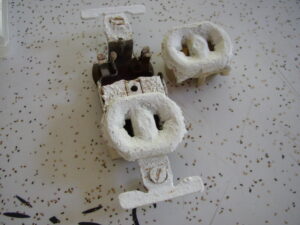
    Incidentally, the old outlet in Andrew’s room was cracked almost in half.  Check it out:

    The outlet was most likely original to the house, and it was plastic, not porcelain.  So apparently they were using plastic outlets back then, but not thermoplastic-coated wire.

  • Browse NFPA codes online

    I just found out that The National Fire Protection Association has a method you can use to browse all of its publications online. This includes the National Electrical Code and its associated offshoots. This is really nice, because printed versions of the NEC (NFPA 70) sell for upwards of $60, and then you still need to get NFPA 7A, which specifically covers single- and double-family dwellings. And on top of that, the codes are updated every three years, at which point you need to buy all-new copies if you want to stay up-to-date. This is a little pricey for a weekend shade-tree electrician like me. However, a copy of the NEC is essential if you want to do safe, code-compliant work that will be approved by an inspector. It’s always been frustrating to me that these documents cost so much — no one, be it contractor or homeowner, professional or amateur, should be required to pay for what is ostensibly a book of requirements. IMO, the high price point of the printed NEC promotes shoddy, non-permitted, non-compliant work, which is not good for anyone.

    Now, all is not perfect. NFPA still wants to make money selling hardcopy and PDF versions of the code, so the free access you get is a bit crippled. It works via a Java applet that doesn’t allow printing, cut-and-paste, or search. However, it’s better than nothing, and I have to give props to NFPA for recognizing the importance of providing easy access to these codes. There are certain things that are more important than making money..

    Oh yeah.. here’s the link.

  • Scaling down the pool project

    Scaling down the pool project

    Over the past weekend, I came to the conclusion that I’ve bitten off more than I can chew with my swimming pool repair project this year.

    The moment of enlightenment came on Saturday, when I spent most of the day working on the pool. It occurred to me that to effectively re-bed my loose coping stones, I’m going to need to grind a lot more mortar off the bond beam than I was originally planning. Otherwise, the stones are either going to be uneven, or they’re going to sit up too high. Grinding the beam down is going to require a power tool such as an electric or pneumatic chipping hammer. And, it’ll make enough of a mess that I think the pool will need to be drained. And, that means it’s not happening this year.

    So, I’ve elected to put off the major repairs until spring (probably late April or early May). This summer, I’ll make repairs to the deck and caulk the expansion joint in the areas where the coping is sound. I should be able to finish that up over the next couple of weekends. Then when I close the pool, I’ll tarp the areas where the coping is off. Then I’ll drain the pool next April around the same time I would normally start up the equipment.

    This past weekend, I got most of the expansion joint cleaned and filled it with foam backer rod. I learned something about backer rod in the process: After about 24 hours in the joint, it “settles” lengthwise. My butt joints now have about 1/2″ of space between them. No problem, I can fill them with little bits of backer rod. But, I’m glad I didn’t caulk right away.

    With the pool empty next spring, I’ll have the opportunity to do some maintenance, such as..

    • Touch-up areas of loose or peeling paint
    • Inspect and re-caulk around light niches, return jets, main drain, etc.
    • Inspect and repair a return jet that appears to have a threadded sleeve stuck in it
    • Patch skimmers where necessary
    • Inspect shell cracks and re-putty where necessary
    • Install an overflow line (maybe)
    • And of course, repair the coping stones and tile in the deep end

    Hopefully after that, I’ll be good for another 5 years.

    I love pool ownership. Really, I do.

  • Pool coping project drones on

    Pool coping project drones on

    Work on the pool coping project continues slowly but surely. I didn’t intend for this to be an all-summer project, but that’s how it’s turning out. The hot weather has really slowed it down, which is not all bad, as it’s keeping me from overextending myself. I’ve done most of my recent work in the early mornings on weekends.

    Today I finally finished prepping the individual coping stones for re-mortaring. This involved using a hammer and chisel to laboriously chip old, loose mortar off the bottom of the stones. From the appearence of the mortar, it looks like someone attempted a similar repair at some point in the past. Hopefully, this one will last a bit longer — that was the idea behind saw-cutting the expansion joint, anyhow.

    Next up is to chip any loose stuff off the top of the bond beam, and finish cleaning out the expansion joint at the deep end. Also, one of the coping stones needs to be glued together. This week I’ll figure out what product I need for that. Weather permitting, next weekend I’ll try to get all this prep work finished up so that I’ll be ready to reattach the stones.

    I will update this entry as I gather info.

  • Load center upgrades

    Load center upgrades

    Continuing in my grand tradition, I’m writing about yet another house project that I’d like to do… the problem, as always, is finding the time for it..

    We have two circuit breaker panels which really should be replaced. They are FPE panels with known safety issues. One panel is our main house panel, and the other is a subpanel. The FPE subpanel is fed by a third subpanel, a Square-D QO type.

    The Square-D subpanel has 20 slots, of which only 9 are currently in use. Because we’ve abandoned a few circuits in the FPE subpanel that it feeds, I could actually squeeze all the circuits into the Square-D if I wanted. However, if I did that, the panel would be full with no room for future expansion. So.. it would probably make sense to replace both subpanels with a single 24-slot Square-D QO type.

    I would need a panel, a cover, and a ground bar kit, as well as a bunch of breakers. It looks like the project would cost around $500. Probably worth it for the safety and peace of mind — maybe I should slate it for this winter.

    The main house panel is a bigger project. I would need to involve BG&E to get them to shut off my power at the meter, and to tell me what kind of service I have — the panel is 150 amps, but it appears that the service may be 200 amps. In this case, I’d get a 200amp, 40-slot panel. This project would probably run closer to $1000. If I can get the subpanel project under my belt this winter, maybe I could tackle the main panel next winter. Again, the main issue is finding time and prioritizing it amongst all the other stuff that has to get done around here.

  • Mortar for pool coping stones

    Mortar for pool coping stones

    I swung by Lowes today to see what kind of mortar (and mortar ingredients) they carry. Neither they nor Home Depot seem to carry white Portland cement, so unless I go through a supplier or lumber yard, it looks like my only choice is gray mortar. However, I’m not sure that’s such a bad thing. Most of the stuff is going underneath the stones, where it won’t be seen. Gray Portland is cheaper than white Portland. What about using gray mortar to bond the stones, then filling in the gaps and other visible areas with white grout? That might be a plan. I just need to look into what kind of “grout” (I put that in quotes, because grout, mortar, etc. all seem to be basically the same thing, namely portland cement, sand, and additives in varying ratios) I would need to get.

    Lowes carrys Quikrete products (Home Depot carries Sakrete). They have a bewildering variety of different Quikrete products on the shelf…

    [More:]

    Number Description Bag Weight Bag Price
    1102 Mortar Mix 60lbs $4.00
    1125 Type N Masonry Cement 70lbs $8.00
    1125 Type S Masonry Cement 70lbs $8.50
    1136 Mason Mix – Type S Mortar 60lbs $4.50
    1136-58 Blended Mortar Mix 80lbs $5.32
    1124 Portland Cement Type I/II 94lbs $9.64
    1103 Sand/Topping Mix 60lbs $4.00
    1230 “Quikwall” Surface Bond Cement – White 50lbs $17.00
    1962 Medium Sand 50lbs $5.00
    1152 All-Purpose Sand 50lbs $2.90
    1133 Vinyl Concrete Patch 40lbs $13.43
    1585 Precision Grout 50lbs $14.00

    The task now, is to go through all of these, check the Quikrete web site to see what’s actually in each of them, and determine which product(s) are appropriate for my job. Stay tuned.

  • Pool coping project underway

    Pool coping project underway

    Today I officially got the pool project underway, after 6 weeks or so of procrastination. After a week of foul weather, I finally got a decent day, so I took off work and rented the concrete saw. It did the job quite nicely, and quickly enough that I only needed a 4-hour rental.

    It took a bit of time to get the hang of the saw, but it was very easy to use. The blade had no problem cutting through the entire slab. The water feed did a great job of keeping the dust to a minimum, and it probably sped the job up by keeping the blade cool. I was not able to cut any of the curved areas, which I sorta expected. Not sure how I would handle these. A 7″ angle grinder might work for the area around the steps, but the corners are a little too tight for any kind of rotary blade.

    Next I need to clear the joint and clean up the mess, which figures to be more time consuming than the cutting. The wet concrete dust forms a kind of pasty mud, which sticks to the deck and won’t fully vacuum up. I’ll probably end up using my pressure washer to clean it off the deck.

    With the joint partially cleared, I can see that a lot of the fill around the pool has eroded over the years, from water seeping into the joint. I’m not planning on doing anything about it, as I’d need to demolish the deck (that’s a job for the next owner of the house). But, once I caulk the joint it’ll stop any further erosion.

    Once I’ve cleaned the joint I may go ahead and fill it (at least partially) with backer rod, to keep junk from falling into it before it’s caulked. Hopefully I’ll be able to finish prepping the joint over the long weekend; then I can focus on re-mortaring the loose coping stones.

    Oh, and the stupid Tulip Poplars have already started dropping leaves, and it’s not even July yet. It’s going to be a long summer..

  • Pool coping project — getting started

    Time to get started on the pool repair project.. better late than never I suppose. I’ve blocked off this coming Thursday to rent a concrete saw and cut back the expansion joint. Also, I’ve been thinking a lot more about what to use to mortar the coping stones in place. Terry Tamminen’s excellent book, The Ultimate Pool Maintenance Manual, includes instructions for making what he calls “patch mix”, using white portland cement and sand. He uses this same stuff (possibly with different ingredient ratios; I don’t have the book here to confirm) for patching plaster, anchoring coping stones, and grouting stones and tile. I think this might be the way to go, rather than buying premixed bags of mortar as I was originally planning. Just need to find a supplier. I’m not too confident that the big boxes will stock white portland. If not, I’ll try my favorite lumber yard. Will work on researching this over the next few days. (Update 6/22.. no sign of white portland at Home Depot).

    Oh, and the loose strip of waterline tile in the deep end fell off all by itself two days ago. I had to dive in to fish it out. Remarkably, it stayed completely intact, leaving me with a roughly 2-foot strip of mortar and pool tile, and the beam behind it is fairly clean too. I need to decide if I want to try to re-attach it, or just start over and retile (I have plenty of extra tile, so either is an option). This is the last step of the project, and won’t be happening until fall when I can lower the water level, so I’ve got plenty of time to think about it.

    [More:]

    6/21: Informative posting on poolforum.com about setting pool tile.

    6/22: Well, I decided to scrap my plans for the day due to unfavorable weather. However, I did go to Home Depot to take a better look at the concrete saw. I found out:

    • They supply all the fuel mixture I need (it’s a 2-cycle engine as I suspected)
    • There is roughly 5-6 inches from the blade to the outer edge of the dolly wheel on one side. This should be sufficient clearance to run the dolly along the pool coping edge. It will be helpful if the wheel height can be adjusted independently on either side to accommodate uneven surfaces.. but, I didn’t think to ask.
    • The saw includes a water feed, which is great because it should really help cut down on dust.
    • I don’t think it’ll fit in my car, so I’ll need to borrow my parents’ pickup.

    Now, I just need to wait for the weather to cooperate, so I can get this done. Based on the 5-day forecast, I might be waiting awhile..

    6/28: The crappy weather is finally moving out of the area, so the job is back on the calendar for Friday. Fingers crossed.

  • Plumbing project finally completed

    Well, I wasn’t sure I’d ever see this day, but the basement plumbing project is finally finished. It went smoothly and pretty much according to plan. No more leaky fitting in the basement, and I now have a working frost free sillcock outside by the pool equipment. I started at 8:30am on Friday, and finished up at around 1:30pm, with lunch and a couple of breaks in between. Lessons learned along the way:

    1. I had originally suspected that our house shutoff didn’t fully shut the water off, but it looks like it does after all. It just takes a long time to drain the house plumbing. When I first cut the pipes apart, I had a persistent drizzle coming out of the cut pipe. At the time, I had opened every faucet in the house except for the bar sink. When I opened the bar sink faucet, the drizzle stopped and I was able to sweat the pipe without using any bread.
    2. I tried to solder one of the joints while there was still some standing water in the pipe near the joint. It took a loooong time before the pipe got hot enough to melt the solder. In the process, the heat from the torch boiled the water off. Despite my worries, I still ended up with a leak-free joint. Next time though, I’ll make sure the joint is a dry as possible before soldering. Barring that, make sure there’s an opening somewhere for the steam to escape.
    3. Don’t hold the torch directly below the joint, or solder will drip into it and foul up the torch tip. Fortunately, they’re cheap..

    This was the biggest project I’ve ever done involving copper sweating. I’ve found that as long as the joints are fully cleaned and fluxed, it’s pretty hard not to end up with a leak-free joint.

    Really glad to finish that one up!